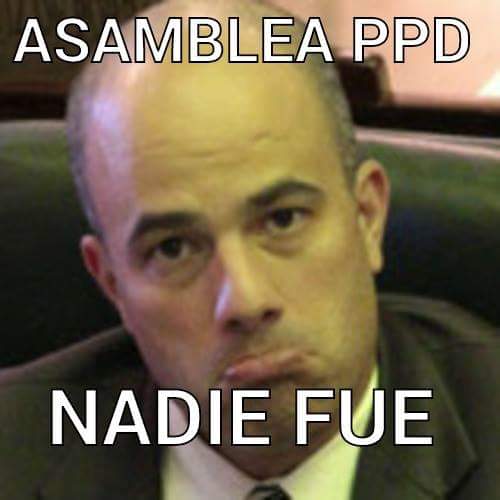
“Es un plebiscito injusto, mal preparado, mal pensado y mal
ejecutado y la decisión de la totalidad de los alcaldes y de la Junta de
Gobierno es recomendar el boicot y al pueblo que no participe. Esa ley está
llena de errores y prejuicios, errores democráticos. Por ejemplo, los encamados
no se pueden cuestionar si un médico dice que es encamado. No hay recuento. Es
una ley hecha para que gane la estadidad y no tengo problema con que gane la
estadidad, pero si gana bien”, expresó Bhatia.
En el barco del boicot los populares
Van a la asamblea general con varias opciones contra la
consulta de estatus
22 de abril del 2017
Really?
Cuando la oposición llama a un boicot es porque sabe que no
va a ganar, podemos pensar que la abstención del voto no es garantía de que
quien gane, logre su objetivo, pero, tampoco es garantía de que ahora será
igual que antes...
Cuando se llevó a cabo el referendum de la unicameralidad,
Pedro Rosselló llamó al boicot, aún así, yo fuí y ejercí mi derecho porque
estaba en contra y estos fueron los resultados.
Referéndum de Unicameralidad (2005):
Opción 1: Unicameralidad – 456,267 (83.4%)
Opción 2: Bicameralidad – 88,720 (16.2%)
Los resultados de este referéndum se desprenden de una tasa
de participación de un 22.3%, entre el Universo de 2,453,292 de electores
hábiles, según las cifras oficiales de la CEE en el 2005.
http://www.noticel.com/noticia/133327/pnp-y-ppd-implicados-en-ignorar-mandatos-democraticos.html
O sea, fue un fracaso para Aníbal Acevedo Vilá, el PPD, los soberanistas y los independentistas, esto sucedió a pesar de que el PNP estaba dividido, por el asunto de los
“Pava-clintons” vs. Pedro Rosselló, esa fue la razón principal de la
abstención de los estadistas que no creen en la unicameralidad.
Los resultados no fueron honrados por el gobierno entrante
del PNP en el 2008, obviamente la abstención ganó, porque el PNP es un partido
de mayoría, pero en el caso de un plebiscito de estatus donde la mayoría de los
puertorriqueños votaría por la estadidad, porque es un problema sin resolver que es la causa principal de la crisis económica y donde la independencia
históricamente no alcanza un 10%, no creo que la opinión de los que no votan
sea tomado en consideración.
¡Despierta Boricua!
En el pasado pleblicito sólo un 33% votó a favor de la libre
asociación —hicieron campaña prometiendo lo mejor de dos mundos, una casi
estadidad y una casi independencia, se reconocieron como los Ni-Ni’s— y los Votos
en blanco alcanzaron sólo 470,032 (26,04%), esos votos no garantizan que sea a
favor de la independencia, porque el voto en blanco, fue un voto pedido por
García Padilla para defender el ELA Mejorado, que obviamente no estaba en la
papeleta porque es inconstitucional, parte de ese voto puede optar por la
opción de la estadidad, porque así fue que se demostró cuando en la primera
pregunta el “Sí” al territorio obtuvo más votos, 798,938 (46,00%).
Esa diferencia de 328,906 votos, entre la primera pregunta y
que no votaron en la segunda pregunta, NO quiere ni la libre asociación, ni la
independencia, tampoco el ELA, por tanto, podrían ser votos por la Estadidad,
porque el ELA Mejorado nunca podrá ser opción en una papeleta por más que lo
defienda Rafael Hernández Colón, que por cierto, luce irracional en sus
planteamientos.
El PPD está acorralado en sus propios embustes y esto no lo
digo yo...
Este Departamento y el Comité Interagencial han rechazado en
repetidas ocasiones como inconstitucional el ELA desarrollado o mejorado fuera
de la cláusula territorial. Es también equivocado decir que la relación actual
entre Puerto Rico y Estados Unidos solo puede alterarse por mutuo
consentimiento.
Y llegó la carta
Redacción de Claridad
Publicado: miércoles, 19 de abril de 2017
¿Es por esto que actúan como el avestruz y pretenden que el
PNP cancele el plebiscito?
¡Cobardes! Después de tanto embuste, la historia los
desenmascaró.
Además, un plebiscito avalado por el Congreso y el
Departamento de Justicia Federal, tiene el poder suficiente para ser tomado en
cuenta. Los antiestadistas deberían pensarlo mejor porque en Puerto Rico las
desiciones se toman en cuenta por el voto, no por una revolución de los
encapuchados que vandalizan propiedad privada y cierran una universidad, eso
tiene muy molestos a los puertorriqueños que desean acabar con esta agonía ya.
En Estados Unidos también los republicanos tienen una lucha con los revoltosos
anarquistas que están creando caos en universidades, vandalizando propiedad privada, y en Washington en las
famosas marchas convocadas por las feministas vestidas de vagina junto a musulmanas que defienden la Ley Sharía, la reacción es encausarlos en
los tribunales, Puerto Rico no va a ser la execpción.
Puerto Rico no es Venezuela, donde las protestas tienen
justificación porque los venezolanos luchan contra una tiranía que viola derechos humanos.
Estados Unidos es dueño del territorio, vivimos en democracia aunque algunos no
lo quieran aceptar y no se va a permitir anarquistas que subvierten el orden.
No crean que el pueblo los apoya.
Lo peor que podría pasar es que el plebiscito sea nulo, eso
lo dudo, porque el presidente Trump no es un hombre que deje pasar las cosas
sin resolverlas, el caso de Puerto Rico merece una solución luego de 119 años y
resulta una irresponsabilidad crasa el fomentar la abstención ciudadana en un
issue que es sumamente importante para el futuro de los puertorriqueños.
No hay
duda que los líderes antiestadistas poco le importa el pueblo, sino mantener su
franquicia política para seguir en la jauja de los millones con el fondo
electoral, puestos en el gobierno y para favorecer a sus amigos del alma.
Todavía no sabemos que contestará Jeff Sessions a la
cantidad de cartas enviadas por los populetes, pero, con toda probabilidad habrá plebiscito, y
los resultados los van a tener que respetar en el Congreso, esto es parte del
proceso establecido por el Task Force de Casa Blanca que aunque no tiene
protagonismo en estos días, fueron quienes trasaron el mapa de ruta hacia la
que hemos logrado hasta ahora, eso el Congreso no lo puede negar, aunque hayan
pasado cinco años o diez.
Los antiestadistas le han prestado mucha atención a la carta
que le envió Jeff Sessions al gobernador Ricardo Rosselló, pero nunca le
prestaron atención a una carta que le envió José Serrano a Orrin Hatch en el
2016 y que retrata claramente el caso de Puerto Rico.
Lea con atención...
Congressman Serrano Asks Congressional Task Force on
Economic Growth in PR to include the Island's Status, Key Health Care Areas, Federal Poverty Programs, and Energy
Reform in Group's Agenda US Representative Jose E. Serrano
August 30, 2016
Congressional Task Force on Economic Growth in Puerto Rico
c/o Senator Orrin G. Hatch
104 Hart Senate Office Building
Washington, D.C. 20510
Dear Task Force Members:
Thank you for the opportunity to provide recommendations to
the Task Force as you decide how Congress can assist Puerto Rico in getting
back on its feet. As the most
senior Member of Congress of Puerto Rican descent, I strongly believe that your
work is crucial in addressing the economic crisis on the island. Towards that end, I think it is
important for the Task Force's recommendations to include the following items,
which will improve the economic development of Puerto Rico and help working
families on the island.
1) Status: By far the most important issue needed to address
economic opportunity and development in Puerto Rico is that of Puerto Rico's
political status. Currently, Puerto
Rico is a U.S. territory subject to congressional authority pursuant to the
Territorial Clause of the Constitution which grants Congress "power to
dispose of and make all needful Rules and Regulations respecting the Territory
or other Property belonging to the United States." Art. IV, Sec. 3, cl.
2. Although those born in Puerto
Rico are U.S. citizens, they are denied basic political rights such as having
full representation in Congress, voting in presidential elections, and having
the same eligibility for various federal programs as those in the states. While those residing in Puerto Rico
cannot vote for their Commander-in-Chief, they can be sent to war and have
fought in every war since World War I.
The Puerto Rican people have been treated unequally for 118
years, and it should surprise no one that the result is that Puerto Rico's
economy is in shambles, its unemployment rate is too high, and hundreds of
thousands of island residents have left for the mainland in search of a better
quality of life. It is clear that
the current economic and fiscal crisis in Puerto Rico is a direct result of
this colonial status- Puerto Rico, as either a state or independent nation,
would have had access to the necessary assistance without further congressional
action. Instead, the island was
forced to beg Congress for even the most meager aid possible.
There are some that will argue that we should first
concentrate on solving Puerto Rico's fiscal crisis and economic problems before
dealing with the political status question. The two issues cannot be separated. Because of its colonial status, Puerto
Rico is not granted billions of federal dollars a year that it would receive
were it a state of the Union. As a
result, in order to provide essential services, the island's government has had
to borrow heavily in order to close the gap. Since its economy has lagged well behind the states for
decades as a result of its colonial status, the island did not have sufficient
economic growth to cover its expenses and service its debt. Therefore, a reasonable person would
conclude that Puerto Rico's problems are a result of its colonial status. In other words, the economic situation
is directly correlated to its political status and until and unless we solve
the political status question, we will not solve the economic situation.
Resolving Puerto Rico's status cannot occur, however,
without a clear invitation from Congress to do so. Thankfully, Congress and the Puerto Rican people have
already taken steps in that direction.
In fiscal year 2014, Congress passed legislation that included $2.5
million to allow Puerto Rico to conduct a plebiscite on constitutional options
to resolve its status. Local
politics have prevented that money from being used, but in the wake of this
economic emergency, consensus has started to emerge that Puerto Rico can no
longer continue as a colony of this country. In 2012, a majority of the Puerto
Rican people voted in a non-binding plebiscite on political status to end the
current colonial status, and a supermajority of 61.2 percent voted in favor of
statehood. Recent polls conducted
in Puerto Rico suggest that 65 percent of the population favors statehood. I believe that this Task Force should
include further funding in its recommendation in order to ensure that this
money is used for its designated purpose, and so that the Puerto Rican people
can choose once and for all.
Further, I believe this Task Force should recommend the
simplest option for resolving the status- H.R. 727, the Puerto Rico Statehood
Admission Process Act. This bill
authorizes a simple up or down vote on statehood for Puerto Rico. A vote on this issue will help clarify
whether Puerto Rico should seek the only other viable option- independence.
Absent serious action in Congress to address Puerto Rico's
status, I strongly believe we in Congress will end up revisiting Puerto Rico's
economic woes again in the future, whether that is a year, a decade, or a
half-century from now.
2) Health Care:
In addition to necessary action on the status issue, there are several
areas that should be addressed by this Task Force. One key component of Puerto Rico's economic revival involves
health care services. Puerto
Ricans pay Social Security and Medicare taxes, but are not eligible for equal
benefits, as explained below.
Absent other congressional action, I believe the Committee should
address the following issues in its recommendations:
* Zika- it is imperative that Congress finally act on the
President's full supplemental request to address the Zika virus. Puerto Rico is
the epicenter of the Zika crisis in the United States, with more than 10,000
diagnosed cases according to the Puerto Rico Department of Health. The President's $1.9 billion supplemental
appropriations request includes significant funding assistance for Puerto Rico
in order to address this crisis on the Island- including $250 million in
dedicated funding from CMS. As a
Member of the Appropriations Conference Committee addressing the Zika crisis, I
have seen the urgent need for these additional funds. If we do not address this public health crisis, then it will
continue to impact the economy of Puerto Rico by driving away much-needed
tourism dollars and affecting the life outcomes and productivity of tens of
thousands of American citizens on the island.
* Inequities in Medicaid and Medicare Funding- within both
of these programs, there are numerous inequities that force the island's
government to divert local funds to help cover gaps in medical coverage. This money could be better used by the
territory to promote economic development. For example, Puerto Rico was not treated equally under the
Affordable Care Act- it was not included in the exchanges, and while it was
given a temporary increase in Medicaid funding that extra allocation is not
equivalent to that of the states, and will run out sometime in the next two
years. This funding crisis, known
as the Medicaid cliff, will reduce federal Medicaid allotments by hundreds of
millions of dollars per year if not addressed by this Task Force. Within Medicare, Puerto Rico currently
receives a truncated funding level under Medicaid in lieu of what they would
receive under the regular formula for the Medicare Part D low-income subsidy (LIS). In the 50 states, the LIS program
provides a subsidy for those who are below 135% of the federal poverty
level. These individuals have
smaller deductibles and lower cost sharing. While Puerto Rico is given a much smaller analogous program,
it is approximately 1/10th of what they would receive under full LIS
participation. Additionally,
Puerto Ricans are not automatically enrolled under Medicare Part B, as is the
case in the 50 states. Parity in
these two programs will allow the Puerto Rican government, and the Puerto Rican
people, to put more money into the economy.
* Hospital Financing- The economic crisis in Puerto Rico has
resulted in numerous problems. One
of the most troubling is the flight of medical professionals, mainly doctors
and nurses, to the 50 states. Much
of this flight is due to insufficient hospital funding, a problem which has
been exacerbated by the high rates of interest for their mortgages and loans
that hospitals have been forced to pay, leaving insufficient money to ensure
quality care and to maintain staff.
Several hospitals have been forced to let staff go. This has resulted in degraded medical
care, and a loss of revenue for the territory's government. The Office of Hospital Facilities
within the Department of Housing and Urban Development is tasked with helping hospitals
refinance their loans through the Section 242 mortgage insurance program. However, despite repeated outreach from
hospitals on the island, not a single one has been able to take advantage of
these services in recent years.
The Task Force should examine ways in which access to the 242 program
can be eased for hospitals in Puerto Rico, in order to allow refinancing by
hospitals on the island that can greatly lower their non-health care
costs. This would allow hospitals
to reinvest in hospital staff and quality care.
3) Federal Poverty Programs: Puerto Rico is excluded from
several federal programs and tax policies that play important roles in reducing
poverty elsewhere in the United States.
Inclusion in these programs will help put money in the pockets of the
poorest individuals and families on the island, and numerous studies have shown
the economic benefit of providing assistance to working families. Money from programs like the EITC and
the CTC is routinely reinvested in the economy, and will provide an economic
boost to the island. Among the
inequities that this Task Force should address are:
* Earned Income Tax Credit (EITC)- Currently, Puerto Rico is
excluded from the EITC, one of our nation's most powerful anti-poverty
programs. With an average family
income well-below that of Mississippi (the lowest ranked state), Puerto Rico is
in dire need of federal assistance to help low-income individuals and
families. Inclusion in this
program will help working families on the island make ends meet, by spending
more income and boosting the economy.
Additionally, inclusion in the EITC will help increase tax compliance
and formal participation in the economy.
* Child Tax Credit (CTC)- Currently, families with three or
more children are eligible for the federal child tax credit, but those with one
or two children are not.
Making these families eligible would provide an additional 300,000
families with much needed assistance. Additionally, the refundable Additional Child Tax
Credit suffers from the same problem, and an unequal formula that is currently
applied only to Puerto Rican families with three or more children. This inequity should be addressed by
the Task Force as well.
* Supplemental Security Income (SSI)- Currently, Puerto Rico
is excluded from participation in SSI, the program for indigent individuals who
are older than 65, blind, or disabled.
Instead, Puerto Rico is provided with a block grant that is miniscule
relative to what individuals would receive were they allowed to participate in
SSI. This is a basic inequity that
hurts the most vulnerable in our society.
Puerto Ricans pay Social Security taxes, and should be allowed to
equally participate in all parts of Social Security.
4) Energy: Energy is an area that needs to be studied by
this Task Force in order to help improve Puerto Rico's economy. Puerto Rico's electrical power prices
are more than twice the average power price in the states. Currently, about half of the island's
electricity is obtained from petroleum, making the island very susceptible to
price volatility in the oil markets.
In order to boost economic growth by increasing productivity,
electricity costs in the island must be reduced. Too often, businesses on the island shut down or do not
expand due to high electricity costs.
Lower electricity costs will attract businesses to commence or expand
operations. Some suggestions into
how to improve the energy sector in Puerto Rico and ultimately lower
electricity prices are the following:
* In order to foster economic growth, the federal government
should provide technical and programmatic assistance so that there are no
surcharges to current electricity rates in Puerto Rico other than rate
increases due to the price of oil.
* The federal government should provide technical assistance
to the government of Puerto Rico in order to discuss ways to open up the
electricity market on the island to competition.
* Federal agencies including the Department of Energy should
provide all available technical and programmatic assistance (i.e. grants,
loans, loan guarantees)-consistent with federal rules and regulations-for
capital improvements and critical energy projects in Puerto Rico, as mandated
by the PROMESA Act, P.L.114-187.
* The Task Force should examine ways to allow Puerto Ricans
access to federal tax credits for renewable energy and energy efficiency
technologies. This will encourage
the use of alternative and renewable energy sources on the island.
* Puerto Rico must have an agile bureaucracy that grants or
declines permits for renewable energy projects in a timely manner comparable to
that of the 50 states, while adhering to all federal and state environmental
rules and regulations.
* The Office of Energy Efficiency and Renewable Energy at
the U.S. Department of Energy should offer technical and other programmatic
assistance to the Commonwealth for the implementation of innovative
technologies with the capability of combining different infrastructure systems
in an integrated manner to effectively mitigate power plant emissions,
efficiently treat and reuse wastewater, and produce biofuels.
* The Department of Energy should develop an energy action
plan for Puerto Rico-as mandated by the Consolidated and Further Continuing
Appropriations Act, 2015 (P.L. 113-235)-that includes recommendations on
reducing the island's dependence on fossil fuels, utilizing U.S. fuel energy
sources, and improving the island's energy infrastructure and overall energy
efficiency.
* State-like treatment should be provided to Puerto Rico
under the Low Income Home Energy Assistance Program (LIHEAP) statute, thereby
helping more low-income households pay their electricity bills.
* Congress should appropriate funds in FY 2017 for a program
that was authorized in 2005. Under
the program, the Secretary of the Interior can award up to $6 million in grants
to harden electric power transmission and distribution lines in Puerto Rico and
the other U.S. territories against hurricane-related damage.
I hope that the Task Force will be able to come together in
a bipartisan manner to create a comprehensive proposal for action to further
assist Puerto Rico in its time of need.
Sincerely,
José E. Serrano
Member of Congress
Congressman José E. Serrano has represented The Bronx in
Congress since 1990.
____________
The NiLP Report on Latino Policy & Politics is an online
information service provided by the National Institute for Latino Policy.
http://myemail.constantcontact.com/NiLP-Report--Puerto-Rico-Debt-Oversight-Board-and-Economic-Task-Force.html?soid=1101040629095&aid=GmXdzPAQ8qw
¿Qué les parece?
Después de esto las cosas han empeorado.
¿Y los antiestadistas llaman a un
boicot?
Esto es imperdonable y sólo demuestra su falta de compromiso en resolver los problemas de los puertorriqueños.
Debería darles vergüenza, pero no se les puede pedir que se
abochornen, porque carecen de esa capacidad que tiene los políticos corruptos y
buscones, porque es más importante su beneficio personal y el de su partido, que
el beneficio del pueblo, como muy bien piensan los “comunistas braga’os”.
¡Ay chus! Eduardo Bhatia,
eres el menos que debes hablar.
Such is Life!